



Healthcare IT downtime costs hospitals an estimated $1.9 million per day. When EHR systems go offline, clinical operations stall, lab results pile up, and patient safety risks multiply. Ransomware attacks, software failures, and vendor outages have made extended downtime a recurring reality for hospitals and health systems across the United States.
These 50+ statistics break down the financial, clinical, and operational toll of healthcare downtime, drawn from government databases, peer-reviewed research, and industry reports.
Key Takeaways
$1.9 million per day: The estimated cost of ransomware-related downtime at healthcare organizations, based on 654 incidents since 2018.
17+ days average downtime per ransomware attack on a healthcare provider, though recovery times are improving.
96% of healthcare institutions experienced at least one unplanned EHR downtime event within a three-year period.
62% of lab results were delayed during EHR downtime events, according to a study published in the Journal of the American Medical Informatics Association.
$9.77 million: The average cost of a healthcare data breach, making healthcare the costliest industry for breaches 14 years running.
Change Healthcare (2024) suffered 6+ weeks of downtime at a remediation cost of $3.1 billion, affecting roughly 190 million individuals.
Healthcare Downtime Cost Statistics
Healthcare downtime carries one of the highest per-minute costs of any industry. The figures vary by hospital size, source, and methodology, but every estimate points to the same conclusion: minutes of downtime translate to millions in losses.
Per-Minute and Per-Hour Costs
1. The average hospital loses an estimated $7,500 per minute of IT downtime. Large hospitals lose closer to $25,000 per minute due to higher patient volumes and more complex clinical workflows. (Censinet)
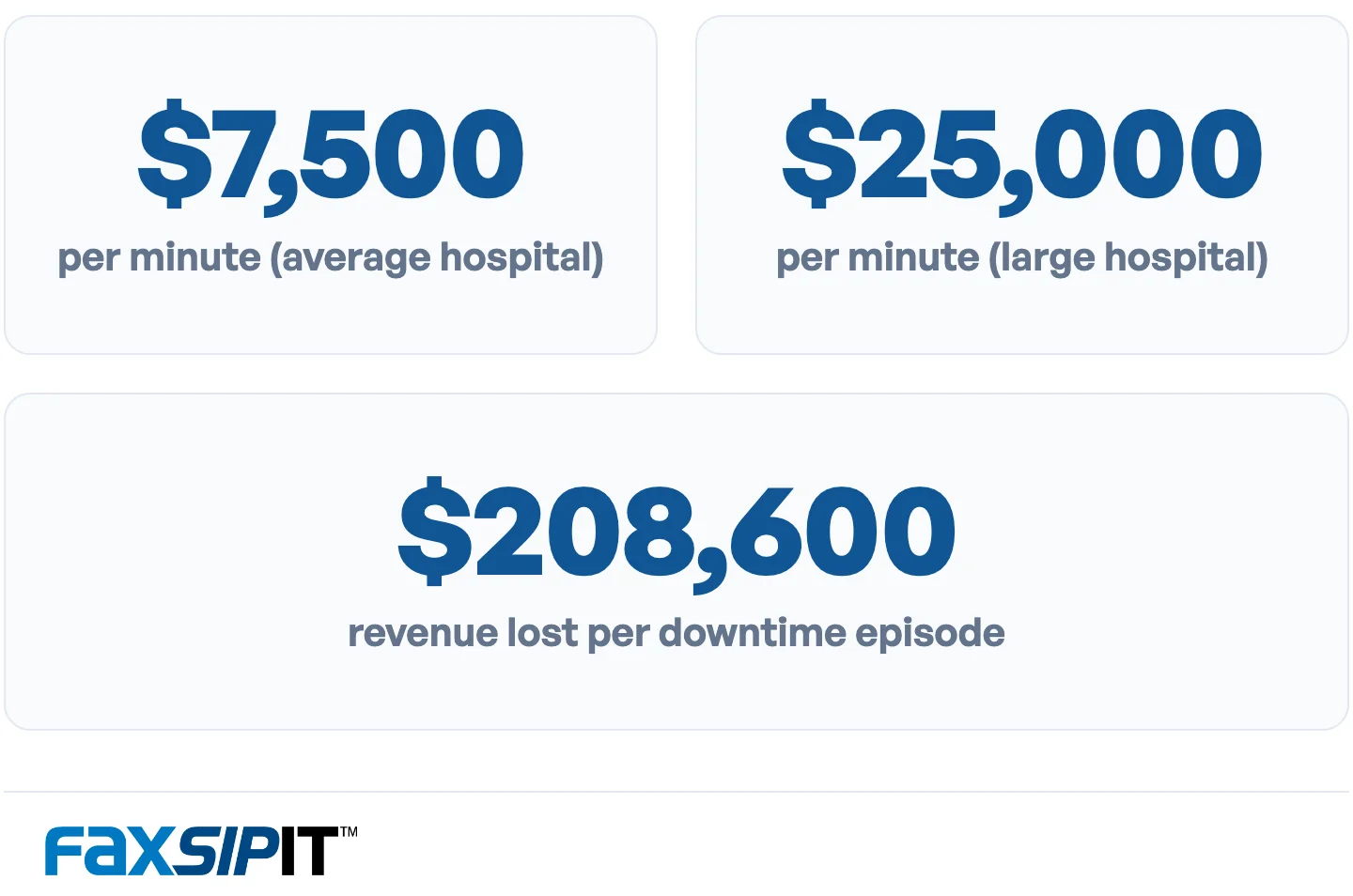
Estimated cost of healthcare IT downtime. Sources: Censinet; healthcare IT downtime research.
2. Healthcare ransomware downtime costs approximately $79,000 per hour, or roughly $1.9 million per day. This figure is based on 654 confirmed ransomware incidents at hospitals, clinics, and pharmacies between 2018 and 2024. (Comparitech)
3. A medium-sized hospital faces estimated downtime costs of $1.7 million per hour. For large hospitals, that figure climbs to $3.2 million per hour. These estimates account for lost revenue from canceled procedures, diverted patients, and delayed billing cycles. (Censinet)
4. Healthcare ranks as the most expensive industry for hourly outage costs, exceeding $5 million per hour in some scenarios, according to an industry survey of enterprise IT decision-makers. (ITIC)
A note on the $7,900-per-minute figure: Many healthcare blogs cite "$7,900 per minute" as the cost of healthcare downtime. This figure originates from a 2013 Ponemon Institute study that surveyed 67 data centers across all industries, not healthcare specifically. The study measured the cost of unplanned data center outages in general, not hospital or EHR downtime. The healthcare-specific figures from Censinet, Comparitech, and ITIC are more recent and more relevant.
Per-Day and Per-Incident Costs
5. A single day of ransomware-related downtime costs a healthcare organization an estimated $1.9 million, factoring in canceled procedures, IT recovery, lost revenue, and staff overtime. (Comparitech)
6. The average downtime episode results in an estimated $208,600 in direct revenue loss from missed appointments, diverted patients, and delayed claims submissions, according to healthcare IT downtime research.
7. Each downtime episode also causes an estimated $138,200 in lost end-user productivity, as clinical and administrative staff switch to manual processes and paper documentation.
8. Healthcare ransomware attacks have caused an estimated $21.9 billion in total downtime losses over a six-year period (2018-2024). This cumulative figure covers 654 confirmed incidents at healthcare providers across the US. (Comparitech)
9. The mean cost to recover from a healthcare ransomware attack dropped 60% year-over-year to $1.02 million, as more organizations adopt faster response playbooks and better backup strategies. (Sophos State of Ransomware in Healthcare)
Cost Metric | Estimate | Source |
|---|---|---|
Per minute (average hospital) | $7,500 | Censinet |
Per minute (large hospital) | $25,000 | Censinet |
Per hour (ransomware) | ~$79,000 | Comparitech |
Per hour (medium hospital) | $1.7M | Censinet |
Per hour (large hospital) | $3.2M | Censinet |
Per day (ransomware) | $1.9M | Comparitech |
Per episode (revenue loss) | $208,600 | Industry research |
Per episode (productivity loss) | $138,200 | Industry research |
Recovery cost (mean) | $1.02M | Sophos |
Healthcare Ransomware Downtime Statistics
Ransomware is the leading cause of extended healthcare downtime. Attacks shut down EHR systems, disable imaging equipment, lock billing platforms, and force hospitals to divert ambulances and cancel surgeries. The frequency has plateaued, but the scale of individual attacks continues to grow.
Attack Frequency and Scale
10. Researchers have documented 654 ransomware attacks on US healthcare providers since 2018, affecting hospitals, clinics, pharmacies, and other care facilities. (Comparitech)
11. In 2024 alone, 181 confirmed ransomware attacks targeted US healthcare providers. That is roughly one attack every two days. (HIPAA Journal)
12. An estimated 88.7 million patient records have been compromised in ransomware attacks on healthcare organizations since 2018. (Comparitech)
13. The HHS Office for Civil Rights received 742 reports of healthcare data breaches (affecting 500+ records) in 2024, and 710 reports in 2025. Not all of these were ransomware. They include hacking incidents, unauthorized access, and system compromises. (HHS OCR Breach Portal, HIPAA Journal)
14. Healthcare breaches in 2024 affected 289.2 million individuals, a figure heavily skewed by the Change Healthcare breach (192.7 million of the total). In 2025, the count dropped to 61.6 million. (HHS OCR, HIPAA Journal)
Downtime Duration and Recovery
15. The average ransomware attack causes 17+ days of downtime at a healthcare organization. That is nearly three weeks of degraded or halted clinical operations. (Comparitech)
16. Recovery times are improving. 58% of healthcare organizations now recover from ransomware in less than one week, up from 21% the year prior. Better backup strategies, faster incident response, and ransomware-specific playbooks are driving the improvement. (Sophos State of Ransomware in Healthcare)
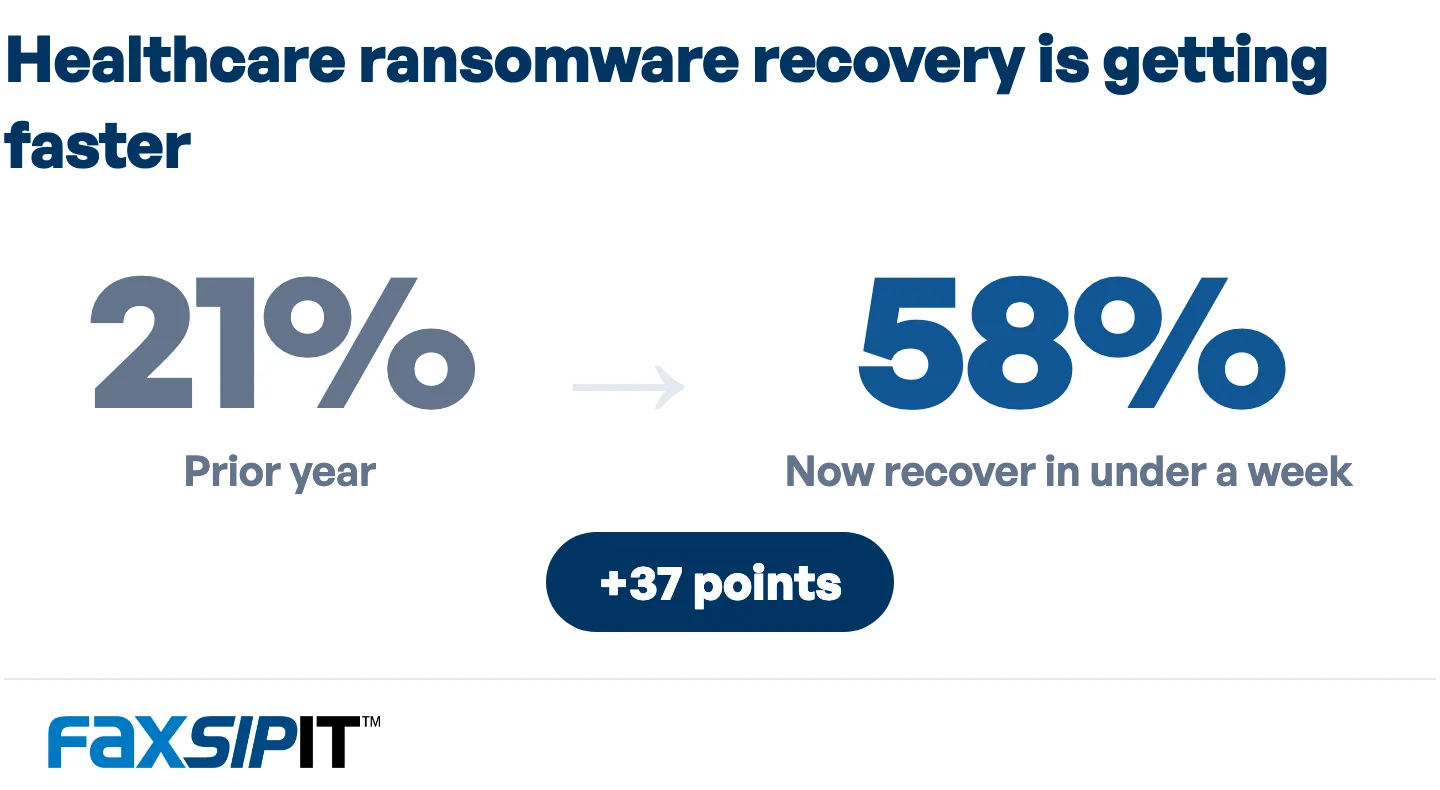
Share of healthcare organizations recovering from ransomware in under one week, year over year. Source: Sophos.
17. Exploited vulnerabilities are the top initial access method for healthcare ransomware attacks at 33%, followed by compromised credentials and phishing. (Sophos)
18. 42% of healthcare organizations cite a lack of skilled people or capacity as the primary organizational root cause of ransomware incidents. Understaffed IT and security teams cannot patch fast enough, monitor around the clock, or respond effectively to alerts. (Sophos)
Patient Safety and Clinical Impact Statistics
The cost of healthcare downtime is not only financial. When EHR systems go offline, clinicians lose access to medication histories, allergy alerts, lab results, and imaging. Younger nurses and physicians who trained entirely on digital systems have never charted on paper. The shift to manual workflows introduces errors that electronic safeguards were designed to prevent.
Care Delays and Medication Errors
19. Lab results are delayed 62% of the time during EHR downtime events, according to a study of downtime incidents at a large academic medical center. Clinicians reported that specimens were lost, orders were duplicated, and results were returned to the wrong provider. (Larsen et al., Journal of the American Medical Informatics Association)
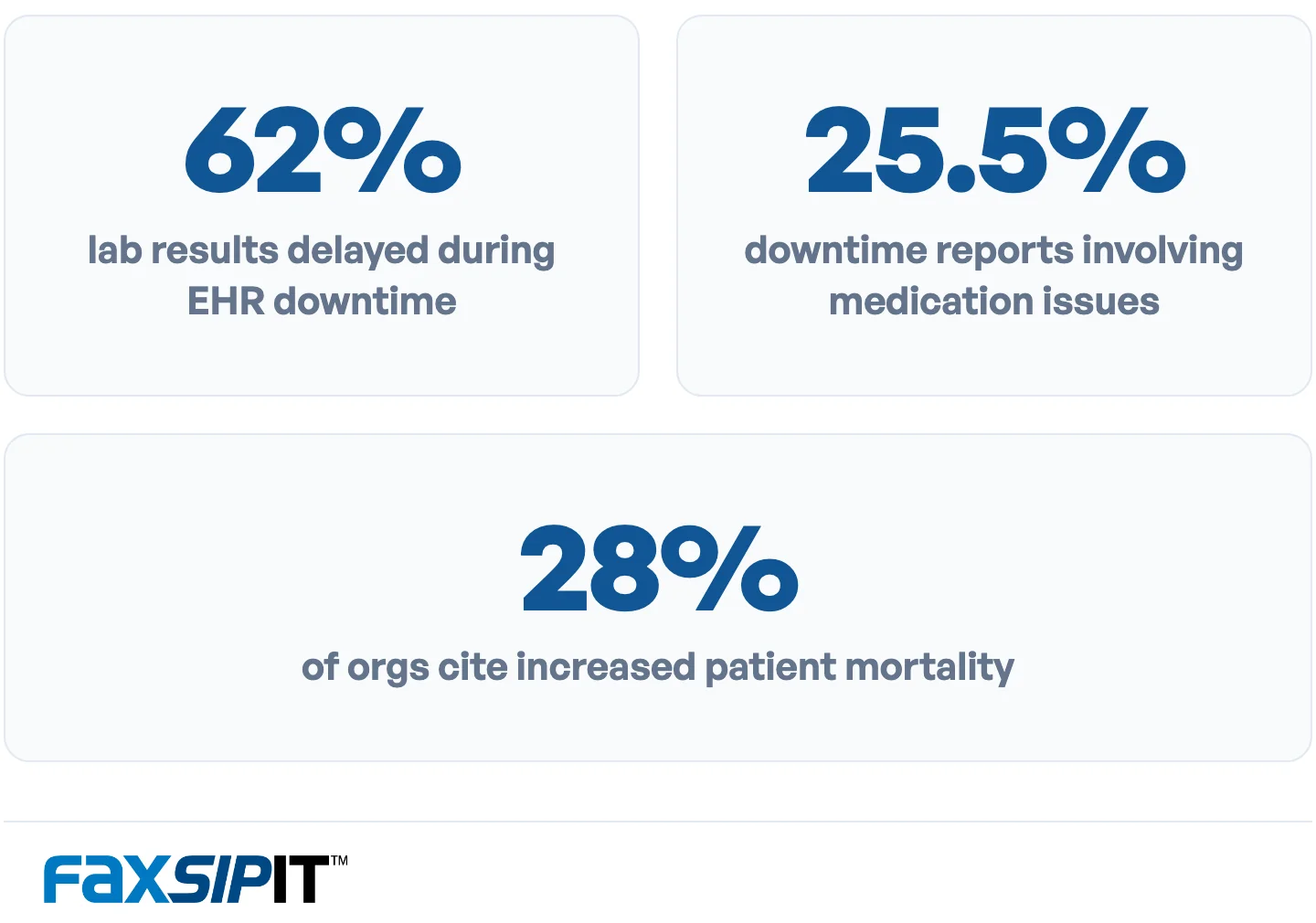
Clinical and patient-safety impact of EHR downtime. Sources: JAMIA (Larsen et al.); Fang et al.; Ponemon/Proofpoint.
20. 25.5% of EHR downtime incident reports involve medication-related issues, including missed doses, incorrect dosages, and failure to check drug interactions without automated alerts. (Fang et al.)
21. Of 204 EHR downtime events analyzed at one health system, 96.1% were unplanned. Scheduled maintenance windows accounted for less than 4% of all outages. (Fang et al.)
22. 56% of healthcare organizations report that cyberattacks caused delays in procedures and tests, with downstream effects on patient outcomes, discharge timing, and bed capacity. (Ponemon Institute / Proofpoint)
Patient Mortality
23. 28% of healthcare organizations report that cyberattacks contributed to increased patient mortality. This finding comes from a survey of IT and security professionals at healthcare delivery organizations. (Ponemon Institute / Proofpoint)
24. Patient mortality rates increase an estimated 20% at hospitals during active ransomware attacks, according to a University of Minnesota study that analyzed mortality data from affected and unaffected hospitals during attack periods. (University of Minnesota / CyberNews)
EHR Downtime Prevalence and Preparedness Statistics
Most healthcare organizations have experienced EHR downtime. The question is not whether it will happen, but how prepared the staff is when it does. The data on preparedness is not encouraging.
25. 96% of healthcare institutions experienced at least one unplanned EHR downtime event within a three-year study period. This near-universal rate suggests EHR downtime is an operational certainty, not an edge case. (AHRQ / ASPR TRACIE)
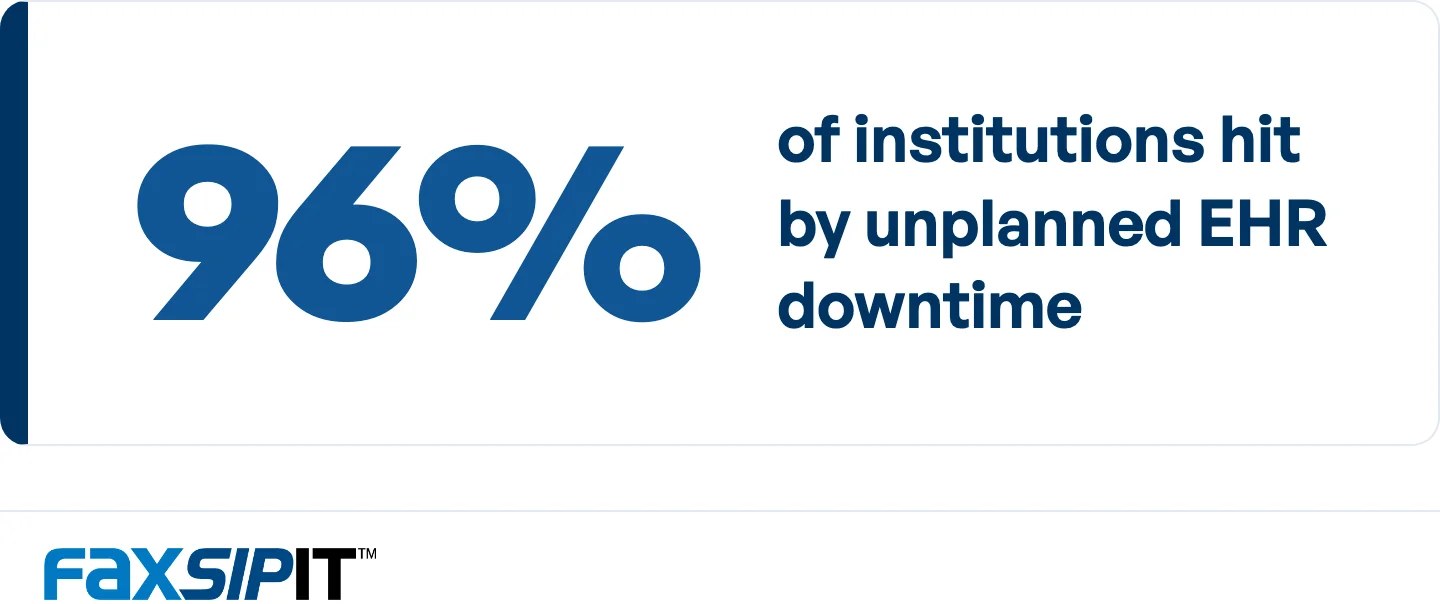
Share of institutions hit by an unplanned EHR downtime event over a three-year study period. Source: AHRQ / ASPR TRACIE.
26. 70% of those institutions reported at least one downtime event lasting 8 or more hours. Extended outages force hospitals to operate on paper for a full shift or longer, disrupting handoffs, medication administration, and clinical documentation. (AHRQ)
27. In 46% of EHR downtime incidents, post-event analysis revealed that downtime procedures were either missing or not properly followed. Staff did not know what to do, did not have access to printed protocols, or reverted to ad hoc workarounds. (AHRQ)
These three findings together paint a clear picture: nearly every hospital will face EHR downtime, most outages last long enough to matter, and almost half the time, staff are not adequately prepared. Organizations subject to HIPAA are required to maintain contingency plans under the Security Rule. For HIPAA violation data and enforcement trends, see our analysis.
Major Healthcare Downtime Incidents
The statistics above represent averages and survey data. The incidents below show what those averages look like when they happen to a single organization.
Change Healthcare (2024)
28. The Change Healthcare cyberattack caused 6+ weeks of operational downtime across the US healthcare payment processing system, beginning in February 2024. Change Healthcare processes roughly one-third of all US healthcare claims.
29. UnitedHealth Group, Change Healthcare's parent company, reported remediation costs of $3.1 billion through the end of 2024, including direct response costs, business disruption, and provider support.
30. Approximately 190 million individuals were affected, making it the largest healthcare data breach in US history.
31. UnitedHealth disbursed $8.5 billion in accelerated loans to healthcare providers to offset cash flow disruptions caused by the payment processing outage. Practices that could not submit claims for weeks faced payroll shortfalls and supply shortages.
Ascension Health (2024)
32. The Ascension Health ransomware attack affected 136 hospitals across 19 states, shutting down EHR access, pharmacy systems, and diagnostic imaging at one of the largest nonprofit health systems in the country.
33. Full operational recovery took approximately 6 weeks. During that period, clinicians reverted to paper orders, manual medication tracking, and phone-based communication.
34. Ascension reported a $1.8 billion operating loss in the fiscal year of the attack, driven by the direct costs of the breach and a sustained drop in patient volume.
35. The breach affected 5.6 million individuals whose personal and medical data was compromised.
36. Patient volume dropped 8 to 12% at affected Ascension facilities during the attack, as ambulances were diverted and elective procedures were postponed.
Other Notable Incidents
37. CommonSpirit Health (2022): A ransomware attack caused 4+ weeks of downtime across the 140-hospital system, with estimated costs of $160 million. The attack disrupted appointment scheduling, patient portals, and prescription management.
38. Scripps Health (2021): A ransomware attack caused approximately one month of downtime, $113 million in total costs, and affected roughly 150,000 patients whose data was exposed.
Incident | Year | Downtime | Estimated Cost | Individuals Affected |
|---|---|---|---|---|
Change Healthcare | 2024 | 6+ weeks | $3.1B | ~190M |
Ascension Health | 2024 | 6 weeks | $1.8B (operating loss) | 5.6M |
CommonSpirit Health | 2022 | 4+ weeks | $160M | Not disclosed |
Scripps Health | 2021 | ~1 month | $113M | 150K |
Healthcare Data Breach Cost Statistics
Data breaches and downtime are closely linked. Many downtime events are caused by breaches, and extended downtime amplifies breach costs through delayed detection, prolonged investigation, and regulatory exposure.
39. The average cost of a healthcare data breach reached $9.77 million in 2024, according to the IBM Cost of a Data Breach Report. The 2025 report shows a decrease to $7.42 million, though the methodology accounts for faster detection times. (IBM Cost of a Data Breach Report)
40. Healthcare has been the costliest industry for data breaches for 14 consecutive years, exceeding financial services, technology, and energy. The regulated nature of healthcare data, combined with long dwell times and complex IT environments, drives the premium. (IBM)
41. HHS OCR received reports of breaches affecting 61.6 million individuals in 2025, down from 289.2 million in 2024. The 2024 spike was largely driven by the Change Healthcare incident (192.7 million of the total). More than 700 healthcare data breaches are reported to HHS annually. (HHS OCR)
Healthcare Communications During Downtime
When EHR systems go down, hospitals do not stop treating patients. They shift to paper charting, phone calls, physical runners, and fax machines. Fax becomes a critical backup channel for lab results, prescriptions, referral letters, and prior authorizations that cannot wait for systems to come back online.
42. More than 70% of US hospitals and clinics still rely on fax for transmitting patient records, including referrals, prescriptions, and insurance authorizations. (HIMSS)
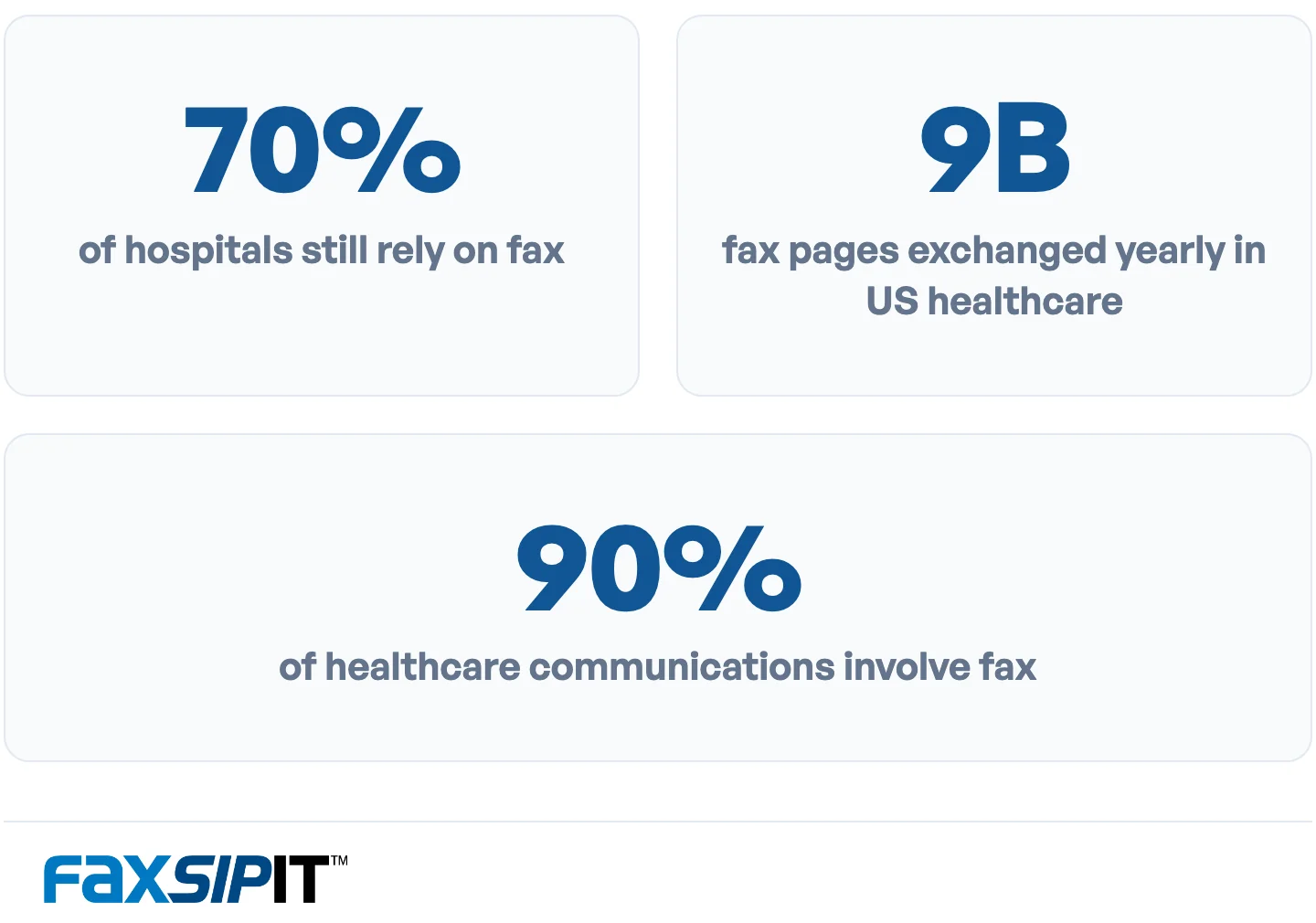
How embedded fax remains in US healthcare workflows. Sources: HIMSS; industry data.
43. An estimated 9 billion fax pages are exchanged annually in US healthcare. The volume reflects how deeply fax is embedded in clinical workflows, not because healthcare is slow to modernize, but because regulatory requirements, EHR interoperability gaps, and cross-organization communication still depend on it.
44. 90% of healthcare communications involve fax at some point in the workflow, whether directly via fax machines or through EHR-integrated fax services that route documents electronically.
45. 89% of healthcare practitioners report that fax-related delays disrupt patient care, pointing to busy signals, failed transmissions, and manual re-entry as common bottlenecks, according to a healthcare communications survey.
During downtime events, the reliability of fax infrastructure matters more than usual. Fax systems built on general VoIP or UCaaS platforms often share the same infrastructure that went down. At FaxSIPit, we operate a dedicated fax network with intelligent multi-carrier retry that runs independently of hospital IT systems. We encrypt every transmission over TLS, and the platform reroutes automatically through alternate carrier paths if any single path encounters an issue. When a hospital's primary systems are compromised, a fax channel on separate, purpose-built infrastructure keeps HIPAA-compliant communications flowing.
Vendor and Third-Party Downtime Risk Statistics
Healthcare organizations do not operate in isolation. They depend on hundreds of technology vendors, payment processors, and service providers. When one vendor goes down, the ripple effects hit every connected organization.
46. The average healthcare organization works with more than 1,300 technology vendors. That vendor concentration creates an expansive attack surface and a long list of potential single points of failure. (Censinet / Pondurance)
47. 41% of third-party data breaches in 2024 affected healthcare organizations, the highest rate of any industry. The Change Healthcare incident is the most visible example, but smaller vendor failures cause downtime across hospitals daily. (Censinet / Pondurance)
48. The CrowdStrike outage in July 2024 demonstrated that non-malicious software updates can cause widespread hospital downtime. A faulty endpoint security update crashed systems at hospitals, airlines, and financial institutions simultaneously. It was not a cyberattack. It was a routine software deployment that went wrong. The incident exposed how a single vendor update can cascade across critical healthcare infrastructure.
49. Change Healthcare processes roughly one-third of all US healthcare claims. The concentration of payment processing through a single platform created a systemic risk that affected providers of every size when that system went offline for six weeks. (HIPAA Journal)
50. HIPAA's Security Rule (45 CFR § 164.308(a)(7)) requires healthcare organizations to maintain contingency plans, including emergency mode operation procedures and data backup plans. Despite the mandate, AHRQ data shows nearly half of organizations lack adequate downtime procedures when an outage actually occurs. (HHS.gov)
FAQs
How much does healthcare downtime cost per hour?
Estimates range from $79,000 per hour for ransomware-related downtime to $3.2 million per hour for large hospitals, depending on the facility size and type of outage. A medium-sized hospital faces an estimated $1.7 million per hour in lost revenue from canceled procedures, diverted patients, and delayed billing.
What is the average downtime from a healthcare ransomware attack?
The average healthcare ransomware attack causes 17 or more days of downtime, covering degraded or fully halted clinical operations. Recovery times are trending shorter: 58% of healthcare organizations now recover in under one week, up from 21% the prior year, according to the Sophos State of Ransomware in Healthcare report. Better backup strategies and ransomware-specific response playbooks are driving the improvement.
What causes most healthcare IT downtime?
Ransomware is the leading cause of extended healthcare downtime, with 181 confirmed attacks on US healthcare providers in 2024 alone. Exploited vulnerabilities account for 33% of initial access, followed by compromised credentials and phishing. Beyond ransomware, vendor outages (such as the 2024 CrowdStrike incident), software failures, and routine EHR maintenance contribute to a near-universal downtime rate — 96% of healthcare institutions experienced at least one unplanned outage within a three-year period.
Are hospitals required to have downtime procedures?
Yes. HIPAA's Security Rule (45 CFR § 164.308(a)(7)) requires covered entities to maintain contingency plans, including emergency mode operation procedures and data backup plans. Despite the mandate, AHRQ research found that 46% of EHR downtime incidents revealed procedures that were either missing or not properly followed.
The Bottom Line
Healthcare downtime costs millions per day, affects patient outcomes, and is getting more frequent. Ransomware is the top cause of extended outages, but vendor failures, software bugs, and infrastructure gaps contribute to a persistent pattern of disruption.
The data does show improvement. Recovery times are getting shorter. More organizations have playbooks in place. The mean cost of ransomware recovery dropped 60% year-over-year. But the scale of major incidents, Change Healthcare ($3.1 billion), Ascension ($1.8 billion), shows that a single event can overwhelm even the largest health systems.
Resilient healthcare operations depend on infrastructure that keeps running when primary systems fail. That includes backup power, redundant networks, and communications channels that operate independently of hospital IT. At FaxSIPit, we build HIPAA-compliant fax infrastructure on a dedicated, fault-tolerant network designed to maintain transmission continuity even when everything else is down.