




Fax has not gone away in regulated enterprises. Hospitals, law firms, banks, insurers, and government agencies still move large volumes of documents by fax because the law and their trading partners require it. The decision for an enterprise is not whether to keep faxing. It is which platform can carry that volume reliably, prove compliance, integrate with existing systems, and migrate the organization without breaking workflows that people depend on every day.
Most "best online fax" roundups rank consumer and small-business apps built around a single mobile inbox. Enterprise buyers need something else: high-volume architecture, a signed Business Associate Agreement, encrypted transport, an API for custom integrations, and a migration path that does not force a rip-and-replace. We co-created HTTPS faxing in 2008 and built FaxSIPit as a fax network purpose-built for regulated, high-volume environments, not fax bolted onto a general voice platform. This guide compares the eight enterprise fax services worth shortlisting in 2026 and the criteria that separate them.
Key Takeaways
Enterprise fax reliability is a platform property, not a protocol one. Consistent delivery comes from managed transport and intelligent multi-carrier retry, not from the underlying fax standard.
HIPAA compliance needs more than encryption. The real requirements are a signed Business Associate Agreement, encryption in transit, configurable retention, and full audit trails on every account.
Migration is the biggest enterprise blocker. The strongest fit lets you keep existing fax machines, numbers, and routing rules while moving the infrastructure underneath to encrypted cloud.
API, Bring Your Own Carrier, and fax-server replacement separate enterprise platforms from inbox apps. These are the features high-volume and multi-department organizations actually evaluate on.
For enterprises modernizing fax without disruption, we put FaxSIPit first — a dedicated managed network plus the SecureFax-ATA hardware bridge.
How We Compared Enterprise Fax Services
We evaluated each service on the criteria that decide enterprise deployments: high-volume handling, HIPAA compliance with a Business Associate Agreement, delivery reliability architecture, a REST or SOAP API, deployment options like Bring Your Own Carrier and hosted fax server replacement, audit trails with configurable retention, migration support, and integrations with existing business tools.
Those criteria matter because fax volume is not shrinking and the cost of failure is real. The global fax services market was valued at $3.31 billion in 2024 and is projected to reach $4.47 billion by 2030, with North America the largest region and cloud-based fax the fastest-growing segment. At the same time, healthcare organizations report that 30% of medical tests must be reordered because the original results were lost or never arrived, and 25% of faxed documents do not reach the recipient before a patient's scheduled visit. A service that handles 50 faxes a month for a single office can fail quietly. A service that handles thousands of pages a day across hundreds of accounts cannot.
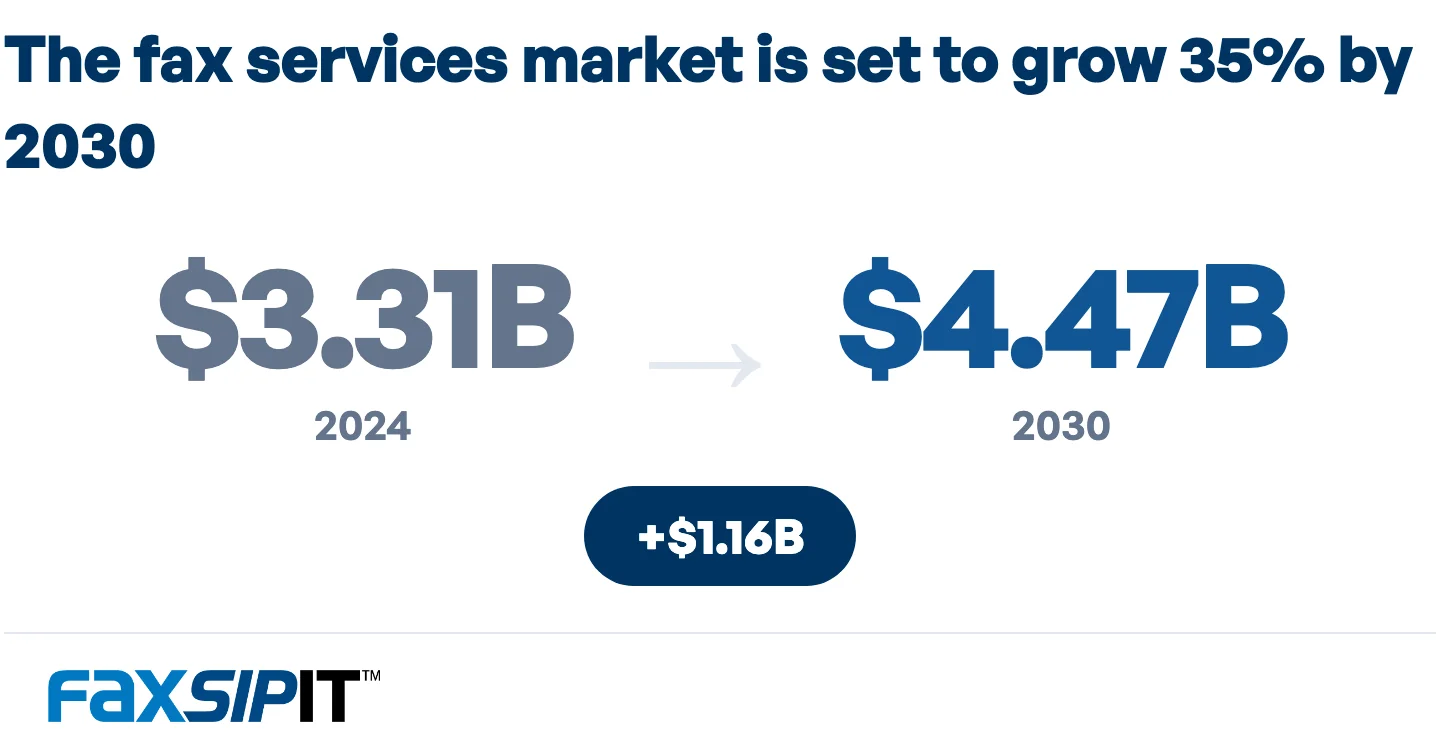
Global fax services market size, 2024 to 2030. Source: Arizton market report.
High-volume handling. Can the platform queue and deliver thousands of pages a day without throughput limits or busy signals at the point of receipt?
Compliance depth. HIPAA with a signed Business Associate Agreement, encryption in transit, audit trails, and retention controls. Some regulated buyers also evaluate HITRUST, FedRAMP, or FINRA requirements depending on their sector.
Reliability architecture. Managed delivery and automatic rerouting matter more than the fax protocol itself.
API and integrations. REST or SOAP APIs for custom workflows, plus connectors for the tools teams already use.
Deployment and migration. Bring Your Own Carrier, SIP trunks, fax server replacement, and a way to keep existing machines and numbers.
The 8 Best Enterprise Fax Services in 2026
Each of the eight is compared at a glance here, then broken down in detail.
Service | Best for | HIPAA + BAA | API | Migration / hardware | Pricing posture |
|---|---|---|---|---|---|
FaxSIPit | Modernizing fax without replacing existing machines | Yes, on every plan | REST | SecureFax-ATA bridge, BYOC, fax server | SMB plans plus custom enterprise (contact sales) |
eFax Corporate | Fortune 500 high-volume document workflows | Yes | Yes | Cloud only | Custom / contact sales |
Documo (mFax) | Mid-sized teams wanting HIPAA in every tier | Yes, built into tiers | Yes | Cloud only | Subscription |
Retarus | Multinational on-premise server migration | Yes | Yes | On-premise and hybrid migration | Custom / contact sales |
OpenText RightFax | Organizations already running OpenText / ECM | Yes | Yes | On-premise / hybrid fax server | Custom / contact sales |
Phaxio (by Sinch) | Developer teams embedding fax in software | Yes | API only | Cloud / developer | Pay-as-you-go API |
SRFax | Solo practitioners and small clinics with no IT team | Yes | Limited | Cloud only | Low-cost subscription |
RingCentral Fax | Teams already standardized on RingCentral UC | Yes | Yes | Cloud, voice add-on | Bundled with UC |
1. FaxSIPit. Best for enterprises modernizing fax without replacing existing machines
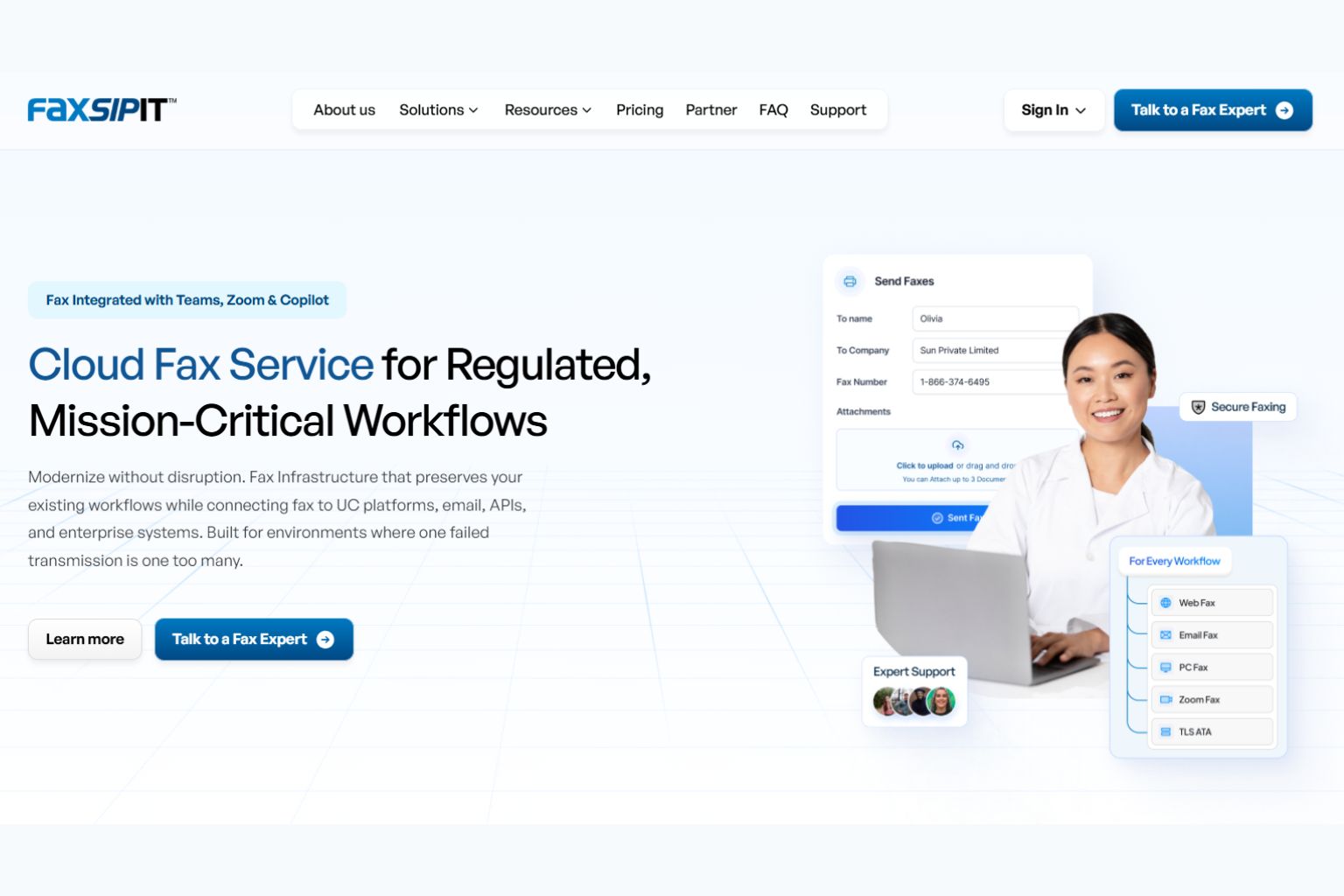
We built FaxSIPit as a HIPAA-compliant cloud fax service on a dedicated managed fax network, for organizations that need to modernize fax infrastructure without disrupting the machines, numbers, and routing their teams rely on. Our SecureFax-ATA device, a proprietary adapter that connects physical fax machines and multifunction printers to the cloud, lets an enterprise move to encrypted infrastructure while keeping the hardware on desks exactly where it sits today.
For high-volume and multi-department deployments, we offer REST and SOAP APIs, Bring Your Own Carrier so you keep existing carrier relationships, SIP trunks, and hosted fax server replacement. Every plan includes a signed Business Associate Agreement, TLS-encrypted transport, full audit trails, and up to seven years of retention. Reliability comes from a managed platform with intelligent multi-carrier retry rather than fax bolted onto a voice system. See our enterprise and institutional solutions for high-volume architecture and the SecureFax-ATA device for the migration path.
Pros: Dedicated fax network with multi-carrier retry; keeps existing machines and numbers; full enterprise stack (API, BYOC, SIP, fax server replacement); BAA on every plan.
Cons: Purpose-built for regulated and high-volume fax, so a single user sending the occasional one-off fax has lighter-weight options.
Who it's for: Hospitals, health systems, law firms, banks, insurers, and government agencies that need compliant, reliable fax at scale and want to migrate without operational breakage.
2. eFax Corporate. Best for Fortune 500 high-volume document workflows
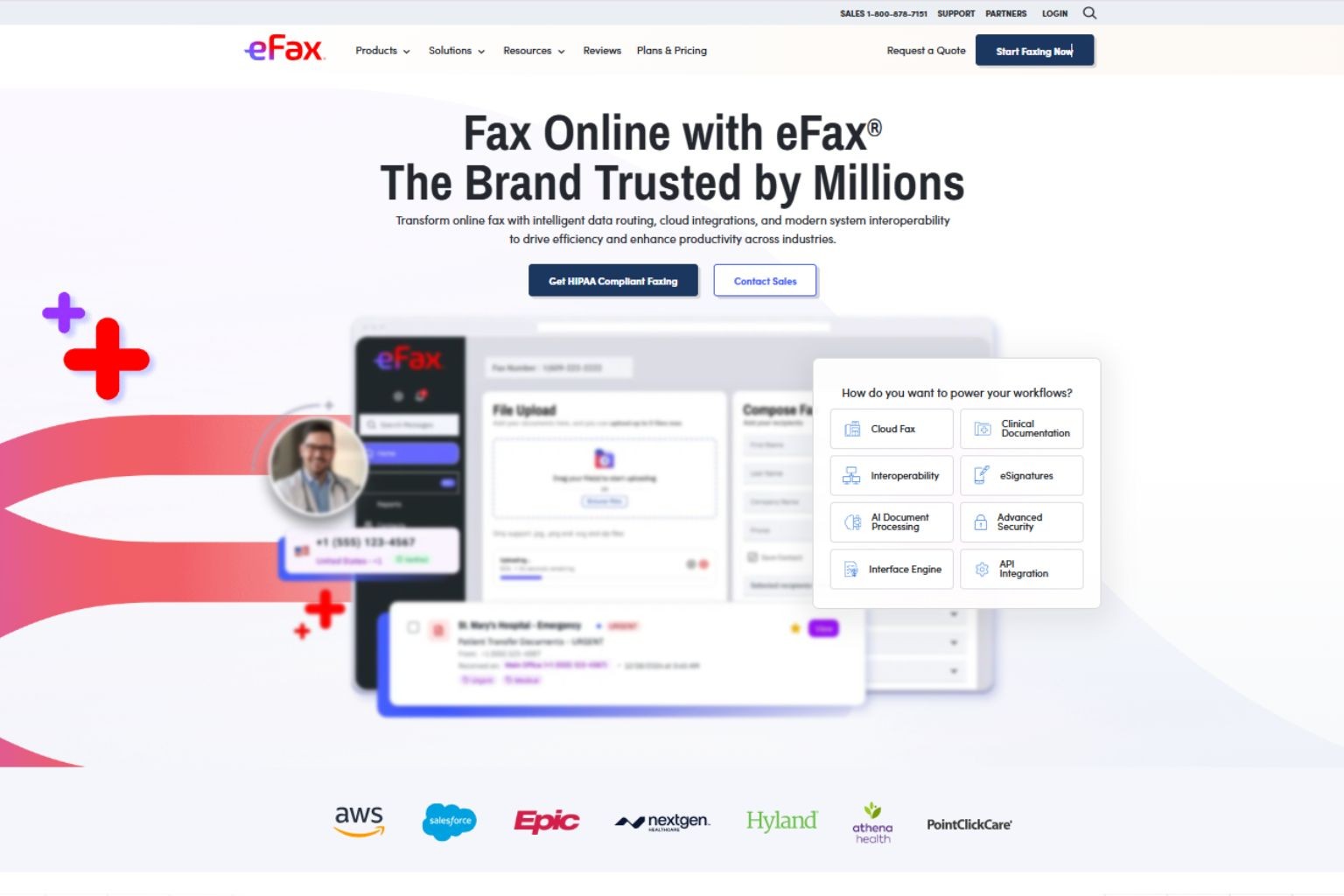
eFax Corporate is the most established name in enterprise fax, with decades of operation and a customer base that includes a large share of Fortune 500 companies. It supports high-volume sending, API access, and deep integrations for organizations running large-scale document workflows.
Its longevity and scale make it a safe shortlist entry for very large enterprises. The trade-offs are a general-purpose feature set rather than purpose-built fax infrastructure, and a cost model that can add per-page and add-on charges as volume grows. Buyers should price the total at their real monthly volume.
Pros: Established at enterprise scale; broad integrations; well-known brand for procurement.
Cons: Add-on and per-page pricing can climb with volume; general-purpose platform.
Who it's for: Very large enterprises that prioritize a long track record and broad integration support.
3. Documo (mFax). Best for mid-sized teams wanting HIPAA in every tier
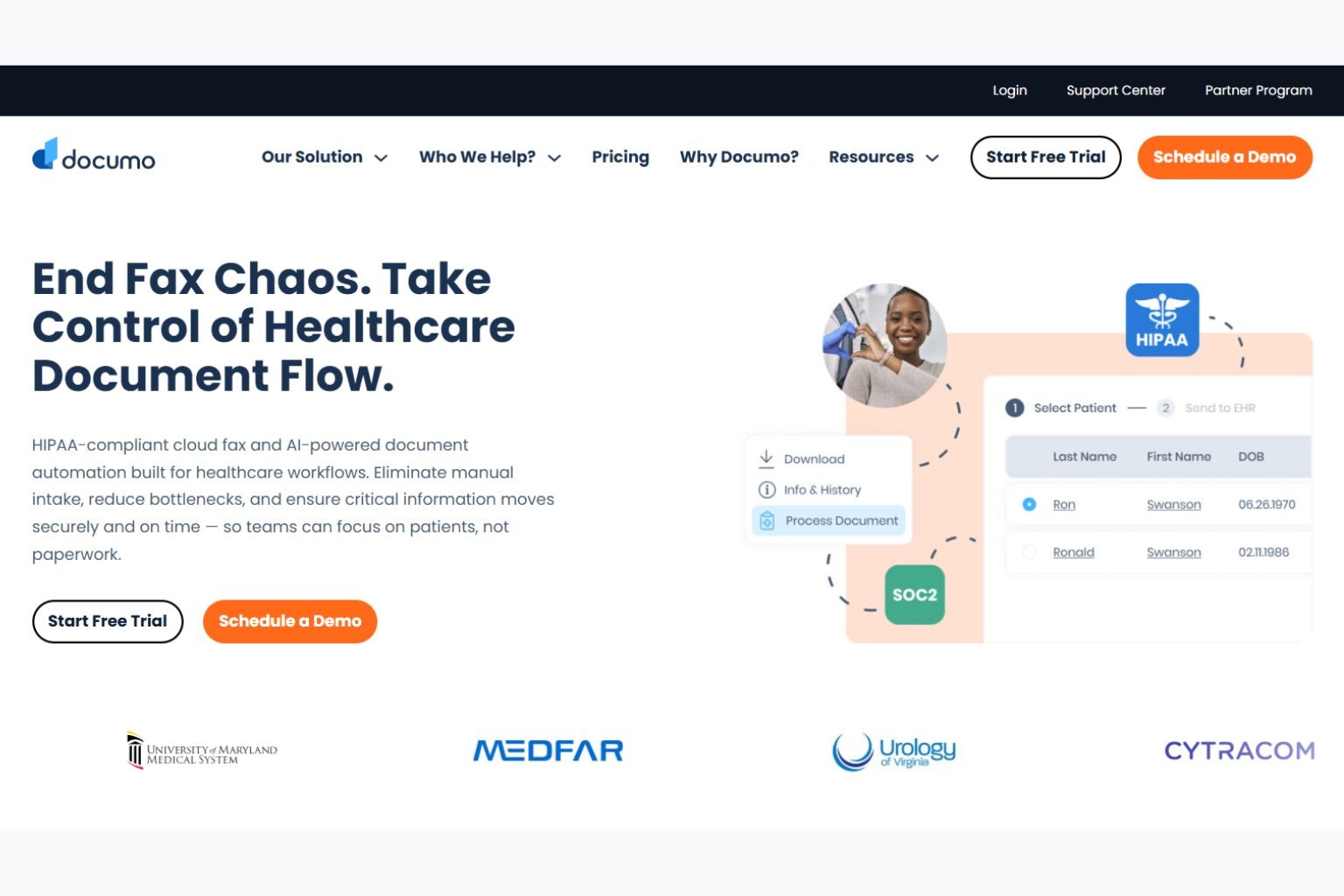
Documo, which markets its fax product as mFax, is a modern cloud fax platform that builds HIPAA compliance into its pricing tiers rather than charging for it as an expensive add-on. It pairs an easy-to-use web platform with an API, which makes it a practical fit for mid-sized teams that want compliance without enterprise procurement overhead.
It is a strong cloud-first option. It has less depth for organizations that need to bridge existing physical fax machines or replace an on-premise fax server, since the platform is cloud only.
Pros: HIPAA included across tiers; clean modern interface; API available.
Cons: Cloud only, with limited hardware migration support; less suited to very high-volume legacy environments.
Who it's for: Mid-sized teams that want built-in compliance and a simple platform without heavy migration needs.
4. Retarus. Best for multinational on-premise server migration

Retarus is an enterprise messaging provider with European roots and a strong record migrating large organizations off on-premise fax servers. It competes for the same enterprise deals as the largest US providers and is built for multinational deployments with on-premise and hybrid options.
For a global enterprise consolidating regional fax servers, Retarus is a serious contender. Its US self-serve and small-business footprint is thinner than the cloud-first brands, so smaller US buyers may find less off-the-shelf tooling.
Pros: Strong enterprise and multinational track record; on-premise and hybrid migration depth.
Cons: Lighter US small-business presence; enterprise sales motion rather than self-serve.
Who it's for: Multinational enterprises migrating on-premise fax servers across regions.
5. OpenText RightFax. Best for organizations already running OpenText or ECM systems
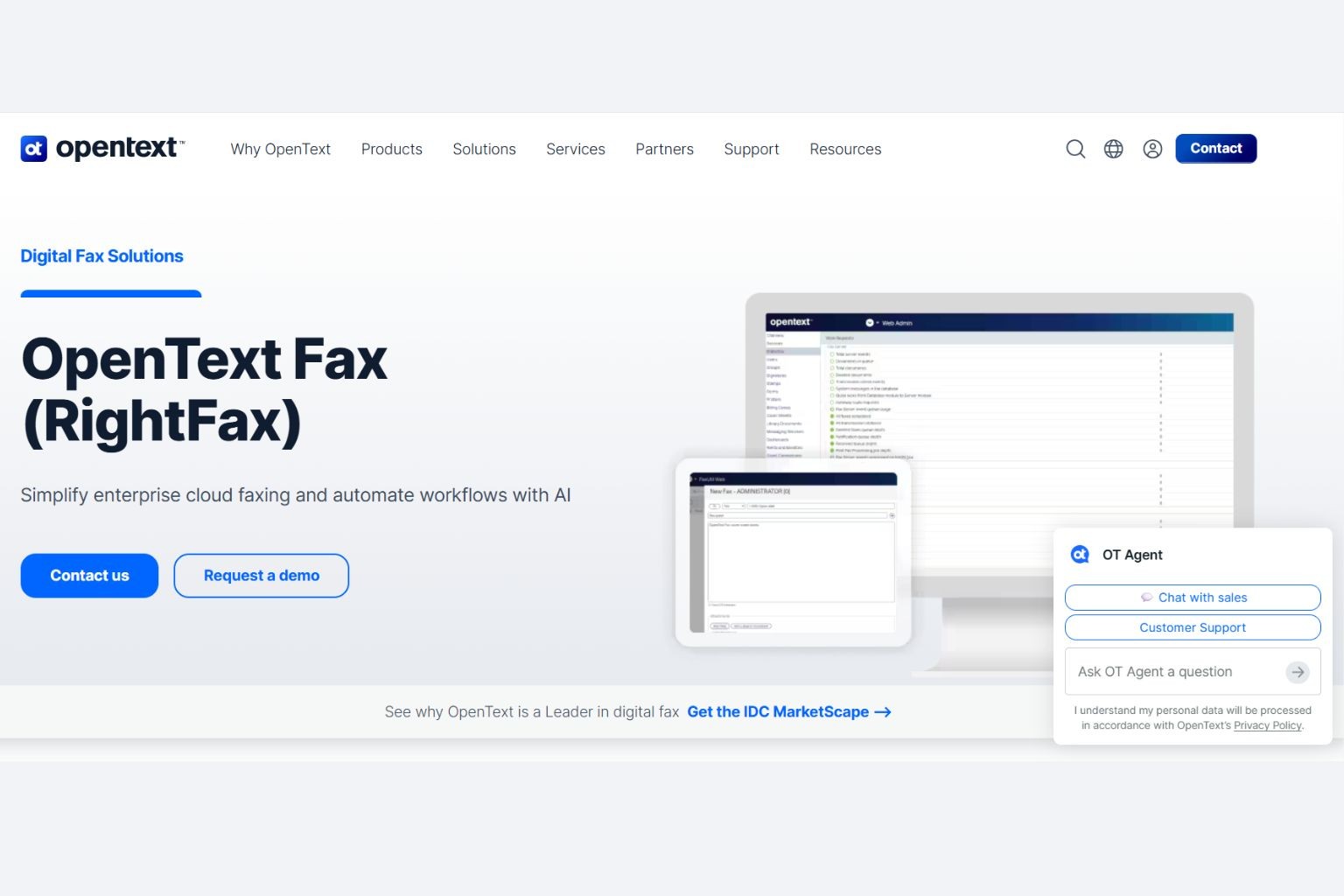
OpenText RightFax is a long-standing on-premise and hybrid fax server platform, and it fits most naturally inside organizations already invested in the OpenText enterprise content management ecosystem. It routes inbound faxes to email or document repositories and integrates with the broader OpenText stack.
Sysadmins describe it as solid and dependable, with the caveat that it is mature, server-based software that carries real administrative overhead. For teams not already in the OpenText ecosystem, a managed cloud platform is usually lighter to run.
Pros: Deep integration with OpenText content management; reliable, server-grade routing.
Cons: Heavier on-premise administration; best value only inside an existing OpenText investment.
Who it's for: Enterprises already standardized on OpenText or ECM document systems.
6. Phaxio (by Sinch). Best for developer teams embedding fax in software

Phaxio, part of Sinch, is a pure pay-as-you-go fax API rather than a traditional front-end inbox. It is built for engineering teams that need to send and receive fax programmatically from their own software, with no user-facing fax client to manage.
For developer-heavy workflows it is an efficient choice. It is not the right tool for non-technical office staff who need a web portal, desktop app, or email-to-fax experience, since the product is API-first by design.
Pros: Clean developer API; pay-as-you-go pricing; good for automation.
Cons: No traditional inbox or office-user front end; requires engineering resources.
Who it's for: Product and engineering teams building fax into their own applications.
7. SRFax. Best for solo practitioners and small clinics with no IT team
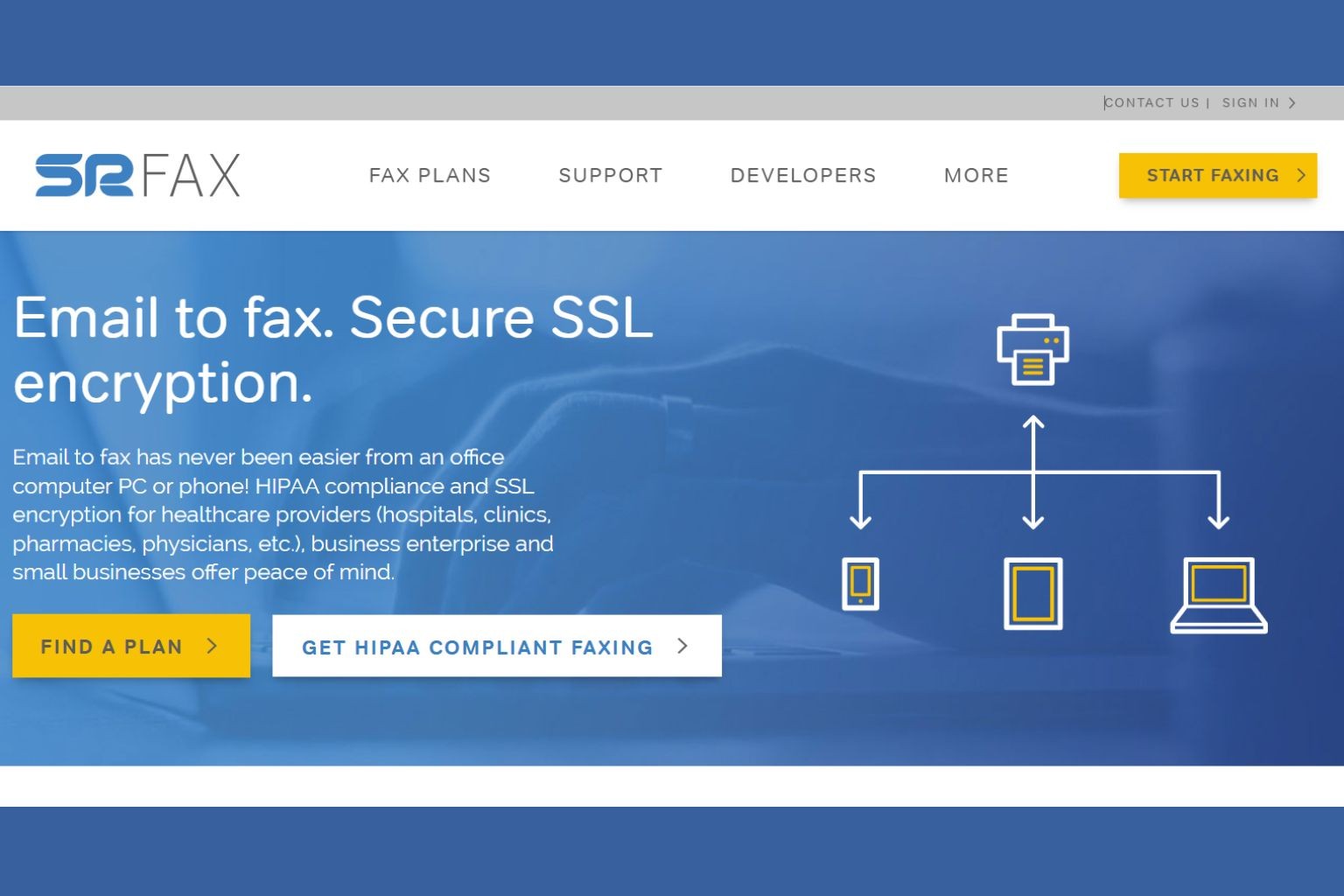
SRFax is a HIPAA-capable cloud fax service that solo practitioners and small clinics repeatedly recommend for being simple to run without dedicated IT support. For a one-doctor practice or small law office that needs compliant faxing and a web inbox, it covers the basics with very little setup.
Its simplicity is also its limit. It is built for small practices, so it offers less depth on API automation, high-volume architecture, and large-scale migration than the enterprise platforms on this list.
Pros: Simple to set up and run; HIPAA-capable; low monthly cost.
Cons: Limited API and enterprise features; not built for high volume or complex migration.
Who it's for: Solo practitioners, small clinics, and small firms that need compliant fax without an IT team to manage it.
8. RingCentral Fax. Best for teams already standardized on RingCentral UC
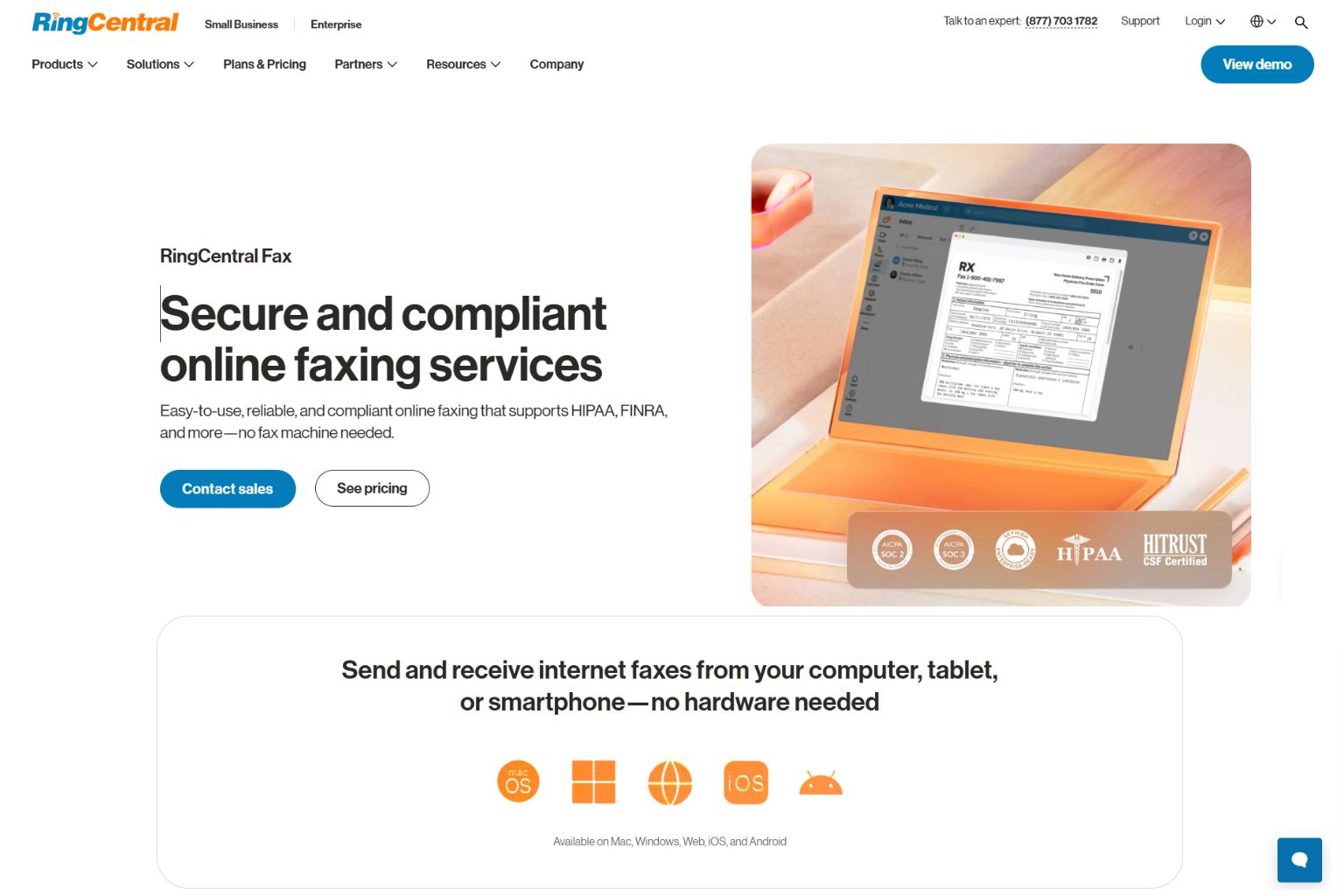
RingCentral Fax bundles online faxing into RingCentral's unified communications platform, which makes it convenient for organizations that already run their phone and messaging on RingCentral. Administrators who want one vendor for voice, messaging, and fax often start here.
The trade-off is structural. Fax is an add-on to a voice and unified communications platform rather than a dedicated fax service, which means it relies on general voice infrastructure rather than carrier routing tuned for fax performance.
Pros: Single vendor for UC and fax; easy for existing RingCentral customers.
Cons: Fax is a voice-platform add-on, not dedicated fax infrastructure.
Who it's for: Teams already committed to RingCentral for unified communications.
What Makes an Enterprise Fax Service Reliable
The most reliable enterprise fax service wins on the platform around the protocol, not the protocol itself. Whether a fax actually lands comes down to four things layered above the fax standard: capacity that is always available, carrier paths chosen for fax, delivery that is managed rather than best-effort, and automatic rerouting when a path fails.
This is where fax bundled into a phone or unified communications system falls short. Treated as a voice add-on, each transmission goes out in real time down a single path. A busy line on the receiving end drops it. Packet loss or jitter on the carrier path drops it. Nothing retries, and nothing reroutes. Across FaxSIPit's network, raw T.38 sending lands 70 to 80% of the time.
A platform built for fax closes that gap. There is no busy signal at the point of receipt, because FaxSIPit's capacity is always open. Each fax is queued, sent over managed TLS and HTTPS transport, and rerouted automatically through a different carrier the moment a transmission stalls. The carrier paths themselves are picked for fax performance, tuned for latency, hop count, interconnect points, and codec negotiation, instead of being inherited from a general voice network. That is why delivery across FaxSIPit's network reaches 95%+ against 70 to 80% for raw T.38.
For an enterprise, that 15-to-20-point gap is a daily operations problem. An organization pushing 1,000 pages a day loses 150 to 200 transmissions on a voice-based setup, and in healthcare each miss can be a delayed referral, a missing prescription, or a compliance exposure. Managed delivery with automatic rerouting is what takes that failure mode off the table. For a closer look at the protocol layer, see our guide to the best fax over IP service.
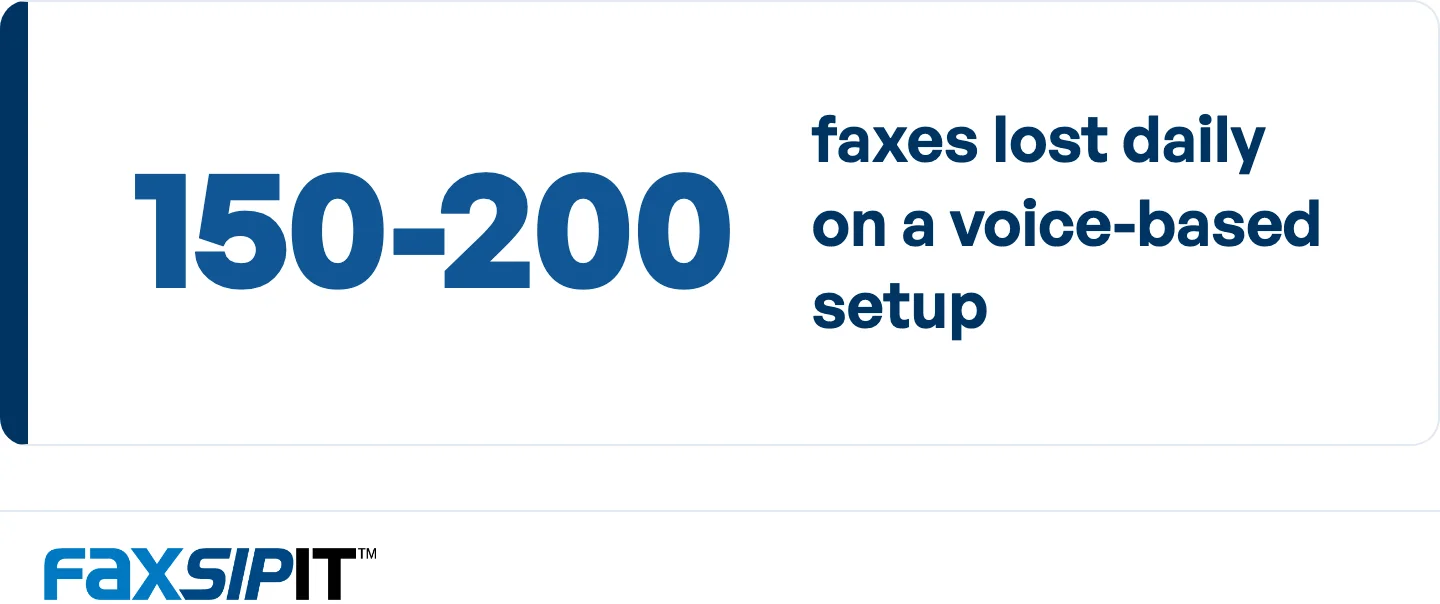
At 1,000 pages a day, a voice-based setup drops 150 to 200 transmissions daily. Source: FaxSIPit network data.
Security and Compliance Requirements for Enterprise Fax
Enterprise fax compliance means encryption in transit, a signed Business Associate Agreement, full audit trails, and configurable retention, not simply a vendor calling itself "secure." For HIPAA-regulated organizations, a Business Associate Agreement is the non-negotiable starting point, because it is the contract that makes a vendor legally accountable for protected health information.
FaxSIPit encrypts the last mile of every fax, on every plan. The reason this matters: T.38 carries no encryption of its own. Carrier backbones are usually private, but the SIP trunk legs that cross the public internet and the final hop to the receiving device travel in the clear. That final leg is the part HIPAA scrutinizes most, and we wrap it in TLS and HTTPS on every transmission. Every account also gets full audit trails and up to seven years of configurable retention. Regulated buyers in some sectors additionally evaluate HITRUST, FedRAMP, or FINRA requirements, so confirm the specific frameworks your organization must meet against each vendor's documentation.
The stakes are documented. More than 700 large healthcare data breaches were reported to federal regulators in 2025, affecting around 62 million individuals, and the year ranked among the busiest on record for HIPAA enforcement. Fax is a specific vector: regulators list misdirected faxes among the impermissible disclosures that trigger reportable breaches, and a single recurring fax error can be expensive. One New York hospital paid $387,200 to settle HIPAA violations after staff faxed sensitive patient information to the wrong recipients. For the compliance-first shortlist, see our roundup of the best HIPAA compliant fax services, and our HIPAA-compliant fax and compliance overview.
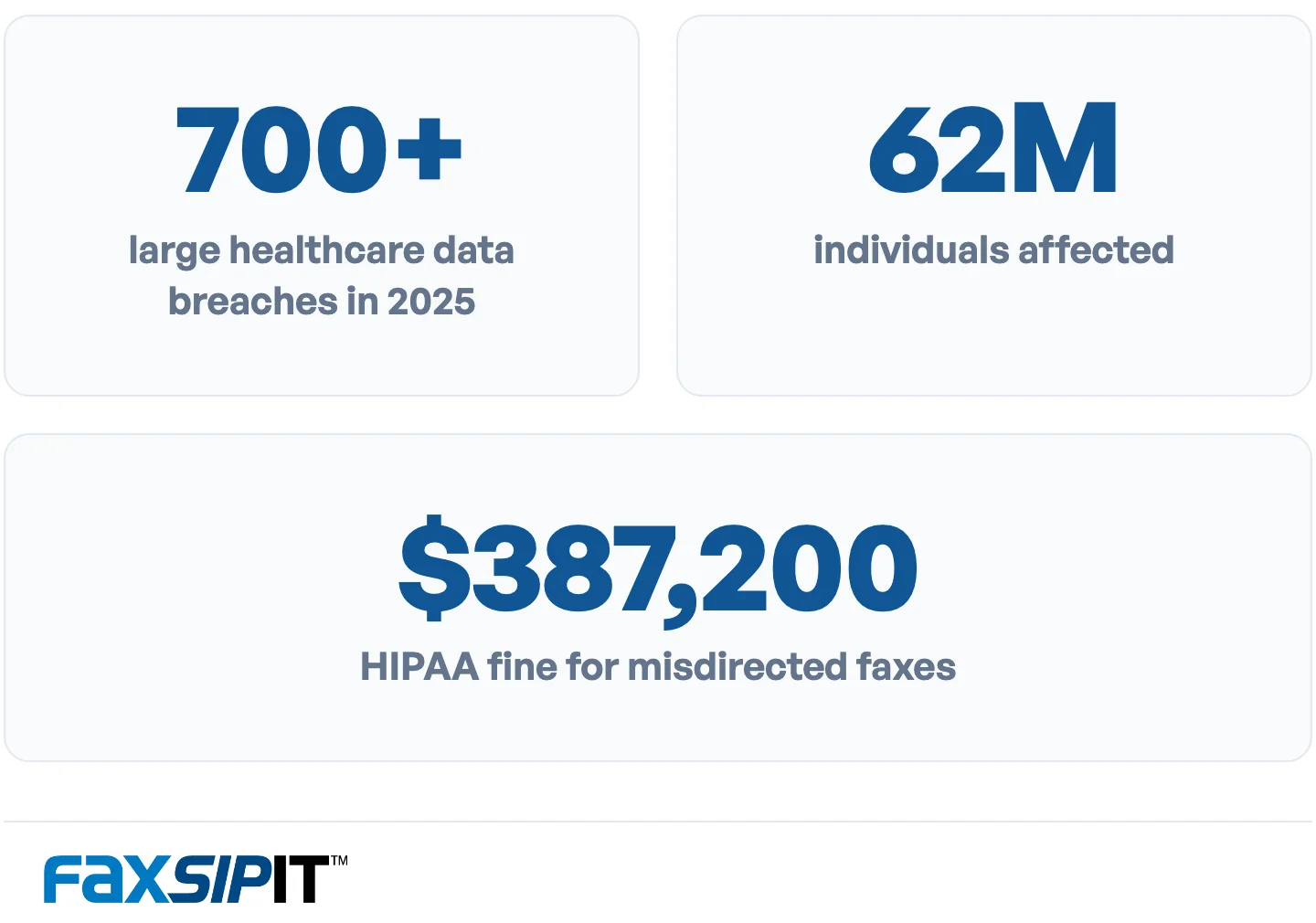
The documented stakes of fax compliance failures. Sources: HIPAA Journal; Healthcare IT News.
Migrating to Cloud Fax Without Disrupting Operations
The biggest enterprise blocker is migration risk, not features. The right service preserves existing fax machines, numbers, and routing rules while moving the infrastructure underneath to encrypted cloud, so staff workflows do not change on go-live day.
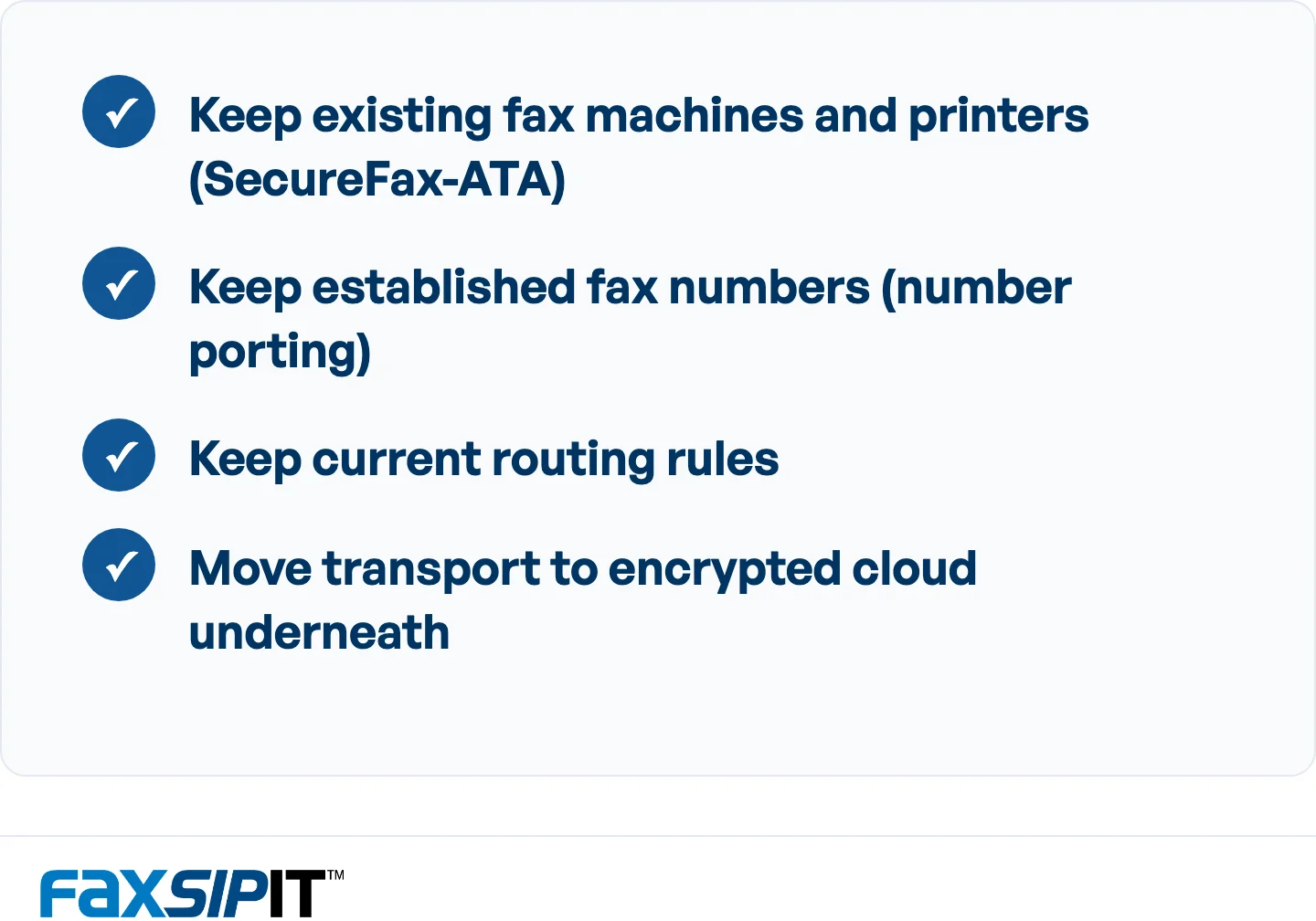
What an enterprise keeps when migrating to cloud fax with FaxSIPit.
SecureFax-ATA, our proprietary hardware adapter, connects existing physical fax machines and multifunction printers to the cloud. Departments keep the devices and shared numbers they use today while transmissions move to encrypted infrastructure. For organizations retiring an on-premise fax server, we offer hosted fax server replacement, plus Bring Your Own Carrier, which means keeping your existing carrier, and SIP trunks for high-volume and multi-department deployments. Number porting moves established fax numbers over without forcing partners to update their records.
Teams can also send and receive fax from the tools they already use, including Microsoft Teams, Zoom, Microsoft Copilot, Google Workspace, and Outlook, which keeps training to a minimum during a migration. This infrastructure also underpins our channel program: we support 300+ resellers across 40+ countries who white-label the platform under their own brand. For the full architecture, see our enterprise and institutional solutions.
Frequently Asked Questions
What is the most reliable enterprise fax service?
The most reliable enterprise fax service is one built on a dedicated managed platform rather than fax added onto a voice system. Reliability comes from queued delivery, optimized carrier routing, and intelligent multi-carrier retry that reroutes automatically when a path fails. We deliver at a 95%+ rate versus 70 to 80% for raw T.38, based on transmission data across our network.
Is online faxing HIPAA compliant?
Online faxing can be HIPAA compliant, but it is not automatic. The service must encrypt protected health information in transit, sign a Business Associate Agreement, and provide audit trails and retention controls. A consumer fax app without a Business Associate Agreement is not HIPAA compliant regardless of its encryption. We include a Business Associate Agreement, TLS encryption, audit trails, and retention on every plan.
Can we keep our existing fax numbers and machines?
Yes. Number porting moves your existing fax numbers to a new provider, and a hardware adapter like SecureFax-ATA connects existing physical fax machines and multifunction printers to the cloud. This lets an organization keep the devices, numbers, and routing rules staff rely on while the infrastructure underneath moves to encrypted cloud.
How much does an enterprise fax service cost?
Enterprise plan starts at $600/month. Smaller organizations can use standard subscription plans, which start in the low tens of dollars per month as of June 2026, while high-volume and custom deployments are priced per organization.
What is the difference between cloud fax and an on-premise fax server?
Cloud fax is delivered as a managed service, with the provider running the infrastructure, carrier relationships, and redundancy. An on-premise fax server is software and hardware the organization hosts and maintains itself. Cloud fax removes server administration and adds managed reliability, while an on-premise server gives direct local control. For a full comparison, see our guide to cloud fax versus a fax server.
The Bottom Line
The best enterprise fax service is the one that carries your volume reliably, proves compliance, and migrates your organization without breaking the workflows people use every day. Reliability is a platform decision, compliance depends on a Business Associate Agreement and encrypted transport, and migration succeeds when you can keep existing machines and numbers instead of replacing them.
For enterprises and regulated institutions, our pick is FaxSIPit: we pair a dedicated managed fax network with the SecureFax-ATA hardware bridge, Bring Your Own Carrier, and hosted fax server replacement — the full stack a high-volume organization needs to modernize without disruption. eFax Corporate suits very large enterprises that prioritize a long track record, Retarus fits multinational on-premise migrations, Phaxio serves developer teams, and SRFax fits solo practitioners and the smallest clinics.
If fax is mission-critical to your operations, start by mapping your monthly volume, the compliance frameworks you must meet, and whether you need to keep existing machines. Then talk to a provider that can meet all three. See our enterprise and institutional solutions or request a custom quote to scope an enterprise deployment.